

COLLABORATION


SCOPUS CITEDNESS

CITATION ANALYSIS


DOCUMENTS:

TOOLS


VISITOR:

KEYWORDS
DIRECT CHAT


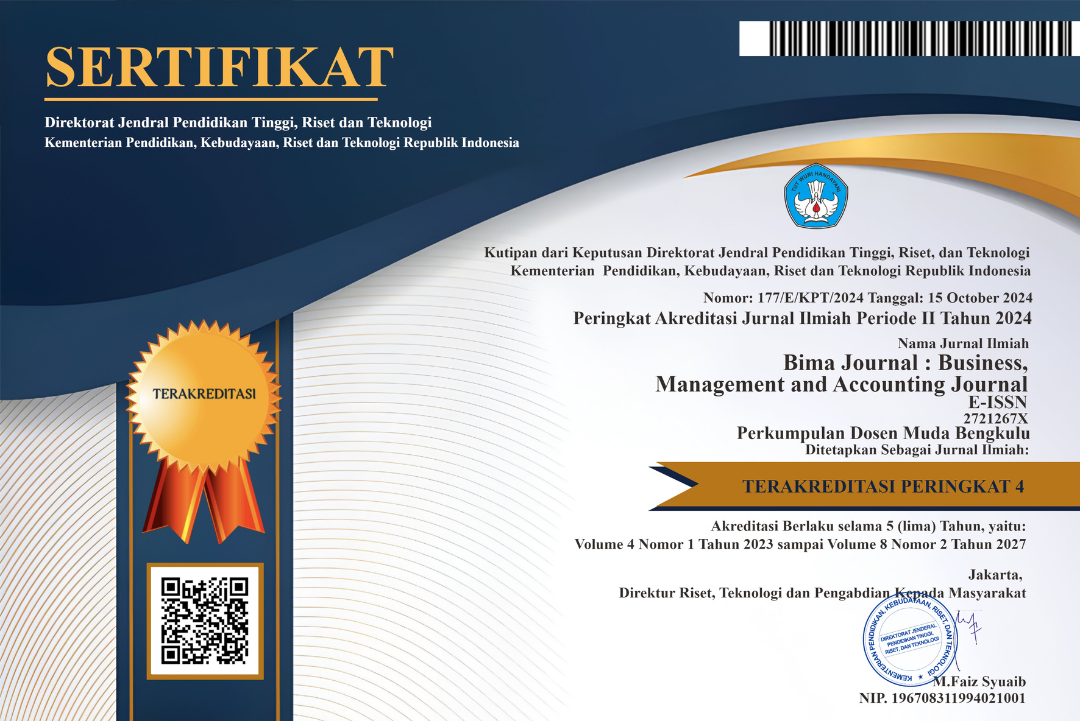
Bima Journal (Business, Management and Accounting Journal)
Publisher: Perkumpulan Dosen Muda (PDM) Bengkulu, Indonesia
Official Journal Website: https://journal.pdmbengkulu.org/index.php/bima
Bima Journal (Business, Management and Accounting Journal), published by Perkumpulan Dosen Muda (PDM) Bengkulu, Indonesia, is committed to promoting constructive scholarly dialogue, academic transparency, critical evaluation, accountability, and research integrity beyond the initial publication of scholarly articles.
The journal recognises that scholarly publication is not the final stage of academic evaluation. Continued discussion, independent scrutiny, methodological criticism, replication, and the emergence of new evidence are essential to the advancement of reliable academic knowledge.
In accordance with internationally recognised principles of publication ethics, including relevant guidance issued by the Committee on Publication Ethics (COPE), Bima Journal encourages responsible post-publication discussion to strengthen scholarly understanding, identify potential inaccuracies, facilitate academic debate, and preserve the integrity of the published scholarly record.
This policy applies to all scholarly articles published in Bima Journal, including original research articles, review articles, conceptual papers, case study articles, and technical or methodological papers.
The policy covers post-publication comments, scholarly correspondence, critical responses, requests for clarification, reports of factual errors, and concerns relating to the reliability or integrity of published research.
All post-publication discussions must be conducted fairly, objectively, transparently, respectfully, and without inappropriate personal, institutional, financial, or commercial influence.
The journal distinguishes between legitimate scholarly disagreement, correctable publication errors, and suspected research or publication misconduct.
Differences in theoretical interpretation, research methodology, or scholarly opinion do not automatically constitute research misconduct.
The principal objectives of this policy are to:
Encourage constructive academic dialogue following publication.
Support transparent examination of published research methods, findings, and conclusions.
Provide appropriate opportunities for authors to respond to substantive criticism.
Facilitate the identification and correction of publication errors.
Ensure that credible research integrity concerns receive appropriate editorial attention.
Protect the reliability, accessibility, and transparency of the scholarly record.
Promote public confidence in academic publishing and responsible research communication.
Authors, researchers, academics, peer reviewers, practitioners, policymakers, students, and readers may submit scholarly comments or questions concerning articles published in Bima Journal.
The journal welcomes evidence-based contributions from individuals with relevant knowledge or legitimate scholarly interests, regardless of their institutional affiliation or professional position.
Participation must comply with the journal's publication ethics, confidentiality, and conflict-of-interest requirements.
Post-publication discussions may address:
Research Methodology: Research design, sampling strategies, measurement instruments, data collection procedures, and analytical methods.
Data Analysis and Interpretation: Statistical analysis, econometric modelling, qualitative interpretation, robustness testing, and the presentation of empirical evidence.
Theoretical Contributions: Conceptual frameworks, theoretical assumptions, hypothesis development, and the interpretation of scholarly contributions.
Research Accuracy and Reproducibility: Numerical errors, inconsistencies in reporting, methodological transparency, data verification, and reproducibility.
Alternative Interpretations: Scholarly explanations, competing theoretical perspectives, or alternative analytical approaches supported by credible evidence.
New Research Evidence: Subsequent empirical findings, replication studies, additional analyses, or newly available information relevant to published conclusions.
Research Limitations: Unacknowledged methodological constraints, contextual limitations, generalisability, and interpretation beyond the available evidence.
Research Integrity Concerns: Potential plagiarism, inaccurate citations, data manipulation, undisclosed conflicts of interest, inappropriate authorship, or other ethical concerns.
The journal welcomes scholarly disagreement when arguments are supported by credible reasoning, appropriate references, or verifiable evidence.
For manuscripts concerning business, management, accounting, finance, and economics, discussions may include:
Reliability and interpretation of corporate financial data.
Accounting measurement, reporting practices, and disclosure quality.
Statistical assumptions and validity of econometric models.
Corporate governance and organisational performance.
Research involving financial institutions, capital markets, or investment decisions.
Marketing research, consumer behaviour, and survey instrument validity.
Management theories, organisational behaviour, and leadership models.
Business sustainability, environmental, social, and governance (ESG) reporting.
Entrepreneurship, innovation, and business development.
Data confidentiality, financial transparency, and research ethics.
Comments concerning commercially sensitive information must respect applicable confidentiality, intellectual property, and data protection requirements.
Bima Journal may facilitate scholarly discussion through the following mechanisms:
A. Letter to the Editor
A concise scholarly communication addressing a substantive issue, methodological concern, interpretation, or limitation in a previously published article.
B. Scholarly Commentary
A structured critical discussion offering additional theoretical, methodological, or empirical perspectives on an existing publication.
C. Author Response
A formal response by the original author or authors addressing scholarly criticism or requests for clarification.
D. Post-Publication Clarification
An editorially assessed explanation of a specific methodological, analytical, or interpretative issue that does not necessarily require a formal correction.
E. Research Integrity Report
A confidential report concerning a suspected ethical violation, inaccurate research reporting, or potential research misconduct.
Research integrity reports are handled under the journal's Allegations of Research Misconduct Policy rather than automatically published as scholarly correspondence.
All participants must:
Present arguments objectively and accurately.
Support substantive claims with appropriate evidence or references.
Address scholarly work rather than attacking individuals.
Maintain professional and respectful communication.
Disclose relevant competing interests.
Respect confidential and proprietary information.
Avoid defamatory, discriminatory, threatening, or abusive statements.
Refrain from making unsupported allegations of research misconduct.
Correct material factual errors identified in their own contributions.
Comply with applicable copyright and publication ethics requirements.
The journal may decline or request revision of comments that fail to satisfy these requirements.
Post-publication comments, scholarly correspondence, requests for clarification, and concerns regarding published articles should be submitted to the Editor-in-Chief of Bima Journal through the journal's official contact channel.
Where the journal establishes a dedicated OJS section for scholarly correspondence, eligible contributions may also be submitted through that section.
Official Journal Website:
https://journal.pdmbengkulu.org/index.php/bima
Submissions should include:
The title of the published article being discussed.
The names of the original authors.
The publication year, volume, and issue.
The article DOI or official publication URL, where available.
The name and institutional affiliation of the person submitting the comment.
A valid contact email address.
A clear description of the issue being raised.
Relevant supporting evidence, scholarly references, or analytical documentation.
A declaration of relevant conflicts of interest.
Where specific errors are alleged, contributors should identify the relevant passages, tables, figures, calculations, or references as precisely as possible.
The journal may request additional documentation when necessary.
The Editor-in-Chief or an authorised handling editor will conduct an initial assessment of submitted comments.
The assessment will consider:
Relevance to the published article.
Clarity and specificity of the issue raised.
Scholarly significance.
Accuracy and credibility of supporting evidence.
Methodological or theoretical validity.
Compliance with publication ethics.
Professional and respectful language.
Potential conflicts of interest.
Suitability for public scholarly discussion.
The editorial team may decline submissions that are irrelevant, substantially repetitive, promotional, abusive, or unsupported by credible evidence.
A decision not to publish a scholarly comment does not remove the journal's responsibility to assess credible concerns about the integrity of a published article.
To promote transparency and timely communication, the following operational timeframes are recommended:
Acknowledgement: Receipt of a post-publication submission should normally be acknowledged within seven working days.
Initial Assessment: Preliminary editorial screening should ordinarily be completed w
COLLABORATION
SCOPUS CITEDNESS
CITATION ANALYSIS
DOCUMENTS:
TOOLS
VISITOR:
KEYWORDS
DIRECT CHAT
BIMA Journal (Business, Management, & Accounting Journal)
P-ISSN: 2721-2971 (Print) dan E-ISSN: 2721-267X (Online)
DOI: https://doi.org/10.37638/bima
Published By:
Perkumpulan Dosen Muda (PDM) Bengkulu
Alamat : Asrama PDm Jalan Mangga 5 E Kelurahan Lingkar Timur Kota Bengkulu
Contact Us: 081328676033/ 082138129668
E-mail : parwitougm@gmail.com/ ekosumartono@relawanjurnal.id

This work is licensed under CC BY-SA 4.0


