

COLLABORATION


SCOPUS CITEDNESS

CITATION ANALYSIS


DOCUMENTS:

TOOLS


VISITOR:

KEYWORDS
DIRECT CHAT


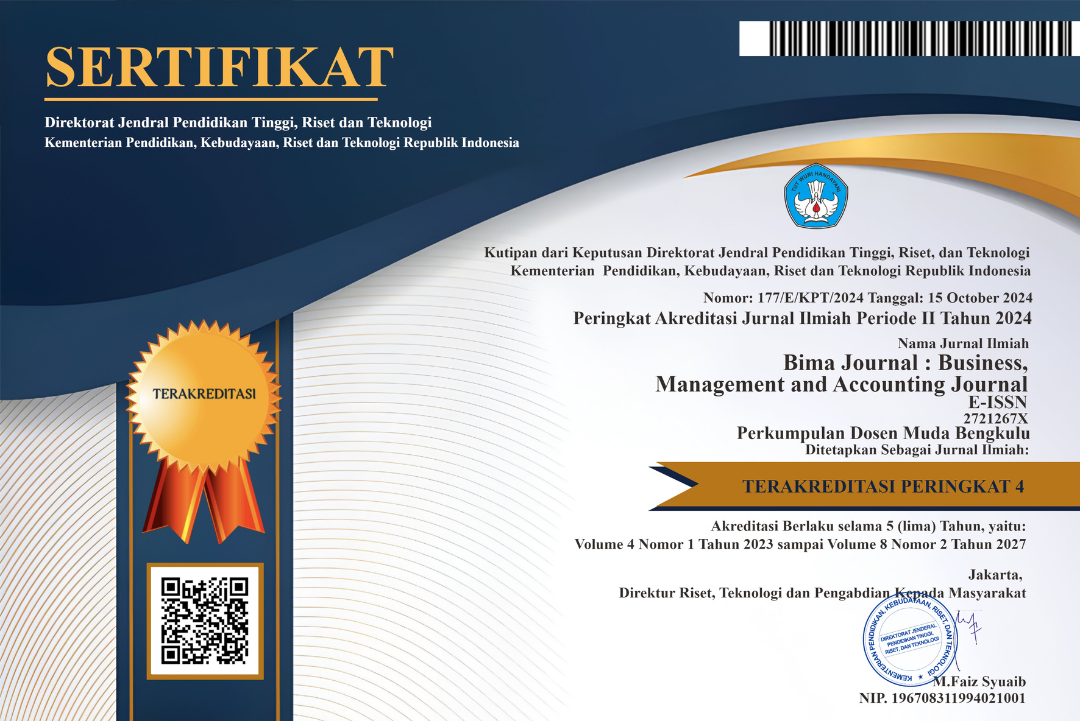
Bima Journal (Business, Management and Accounting Journal)
Publisher: Perkumpulan Dosen Muda (PDM) Bengkulu, Indonesia
Official Journal Website: https://journal.pdmbengkulu.org/index.php/bima
Electronic Archive: https://journal.pdmbengkulu.org/index.php/bima/issue/archive
Bima Journal (Business, Management and Accounting Journal), published by Perkumpulan Dosen Muda (PDM) Bengkulu, Indonesia, is committed to ensuring the long-term accessibility, integrity, authenticity, security, discoverability, and continuity of its published scholarly content.
As an international, peer-reviewed, open-access scholarly journal covering business, management, accounting, finance, economics, entrepreneurship, and related disciplines, Bima Journal recognises that digital preservation is essential to maintaining the reliability of the scholarly record and the sustainable dissemination of academic knowledge.
The journal uses Open Journal Systems (OJS) to manage manuscript submissions, editorial workflows, online publication, article metadata, and electronic archiving.
Its electronic archive provides public access to previously published issues and articles, supporting the continued availability and dissemination of scholarly research.
This policy establishes the principles, responsibilities, and recommended procedures governing electronic archiving, digital preservation, data security, publication metadata, repository integration, backup management, and long-term access to published content.
The policy distinguishes between routine electronic archiving, operational data backup, and independent long-term digital preservation.
These activities serve complementary purposes and must be implemented through appropriate technical, organisational, and administrative arrangements.
Bima Journal maintains an electronic archive of its published issues and scholarly articles through its official Open Journal Systems (OJS) platform.
The electronic archive provides public access to published journal content, including article titles, author information, bibliographic details, abstracts, publication dates, and available full-text files.
Published articles are organised according to their respective volumes, issues, and publication years to facilitate scholarly discovery, retrieval, citation, and long-term access.
The electronic archive of Bima Journal contains published issues dating from Volume 1, Number 1 (2020).
The archive is updated as new articles and issues are published.
The journal is committed to maintaining continued access to its historical publications and preserving the integrity of previously published content.
Published articles should remain publicly accessible through their designated article landing pages and the journal's electronic archive.
Article records should include accurate bibliographic information and functional links to available full-text files.
Official Electronic Archive:
https://journal.pdmbengkulu.org/index.php/bima/issue/archive
Bima Journal recognises the importance of preserving scholarly publications and protecting the integrity of the academic record.
The journal's digital preservation objectives are to:
Maintain the long-term accessibility of published scholarly content.
Protect published articles against unauthorised alteration, corruption, or accidental deletion.
Preserve accurate bibliographic metadata and article identifiers.
Support the authenticity and reliability of archived publications.
Reduce the risks associated with hardware failure, software malfunction, cyberattacks, and technological obsolescence.
Support content recovery following technical disruptions.
Maintain the continuity of scholarly access during platform migration or changes in publishing arrangements.
Support independent verification and the preservation of the scholarly record.
Digital preservation arrangements should cover:
Published journal articles and their full-text PDF files.
Other published article formats, where available.
Article titles, abstracts, keywords, and bibliographic metadata.
Author names, affiliations, and persistent identifiers.
DOI records and associated publication information.
Journal volumes, issues, and publication dates.
Published supplementary materials and research appendices.
Corrections, retraction notices, and other post-publication editorial records.
Relevant copyright and licensing information.
Confidential manuscripts, unpublished research data, reviewer reports, and editorial correspondence require separate access restrictions and retention arrangements.
The journal should maintain procedures to minimise the risk of unauthorised changes to published content.
Where technically feasible, file-integrity verification methods, such as cryptographic checksums, version records, and documented access controls, should be used to detect unintended modifications or file corruption.
Published articles must not be silently altered in ways that compromise the scholarly record.
Substantive corrections, retractions, and other post-publication changes must be handled transparently through the journal's relevant editorial policies.
Bima Journal provides open access to its published scholarly articles through its official website.
Readers may access available articles and download full-text files without subscription barriers or payment for access.
Previously published issues remain accessible through the journal's Archives section.
The archive supports scholarly research, teaching, academic communication, evidence-based decision-making, and the dissemination of knowledge in business, management, accounting, finance, and related disciplines.
The journal aims to maintain stable access to published article records and their associated full-text files.
Temporary interruptions caused by technical maintenance, server failure, platform upgrades, or other operational circumstances should be addressed through appropriate recovery procedures.
Access, sharing, reproduction, and adaptation of published materials are governed by the journal's applicable copyright and licensing policies.
Users must provide appropriate attribution and respect any clearly identified third-party rights or legal restrictions.
Bima Journal maintains bibliographic information associated with its published articles through its OJS platform.
Relevant metadata include:
Article title.
Author names and institutional affiliations.
Abstract and keywords.
Journal title.
Publication year and date.
Volume and issue information.
Page range or article number, where applicable.
Digital Object Identifier (DOI), where assigned.
Article language.
Copyright and licensing information.
Metadata should be accurate, complete, and consistent across the journal website, article files, DOI registration records, and relevant scholarly indexing services.
Bima Journal uses Digital Object Identifiers for published articles where assigned.
DOIs support persistent identification, reliable citation, digital discovery, and linking between scholarly resources.
The editorial and technical management teams should maintain accurate DOI metadata and ensure that registered identifiers resolve to the appropriate article landing pages.
The journal should periodically verify the accuracy and completeness of publication metadata.
Errors involving article titles, author identities, affiliations, publication details, or persistent identifiers should be corrected through appropriate editorial and metadata management procedures.
Where articles or publishing infrastructure are migrated to a new platform, the journal should preserve existing identifiers and implement appropriate redirects to maintain access to previously published materials.
DOI records should be updated when the corresponding article landing-page URLs change.
Authors publishing in Bima Journal retain copyright ownership of their original scholarly contributions.
The journal is granted the non-exclusive right of first publication in accordance with its Copyright and Licensing Policy.
Published articles are distributed under the Creative Commons Attribution-ShareAlike 4.0 International (CC BY-SA 4.0) licence, unless an individual publication explicitly states otherwise.
This licence permits sharing, reproduction, redistribution, translation, and adaptation, including commercial reuse, provided that the applicable attribution and ShareAlike requirements are satisfied.
Official Licence URL:
https://creativecommons.org/licenses/by-sa/4.0/
Authors may deposit and share the published versions of their articles through institutional repositories, subject repositories, personal academic websites, and other lawful scholarly communication platforms.
When depositing published articles, authors are encouraged to retain:
Complete bibliographic citations.
The journal's original publication details.
The DOI or official article URL.
Copyright and licence statements.
Identification of any subsequent modifications.
Third-party content incorporated into published articles may be subject to separate intellectual property rights and licensing conditions.
Authors and repository users remain responsible for complying with applicable copyright permissions and restrictions.
The journal supports appropriate repository-based archiving arrangements to improve accessibility, dissemination, discoverability, and the resilience of published scholarly materials.
Repository deposition complements but does not automatically replace the need for systematic preservation, integrity monitoring, and reliable recovery arrangements.
Bima Journal recognises that website-based archiving and long-term digital preservation are related but distinct responsibilities.
The continued availability of articles through OJS alone does not guarantee protection against permanent content loss, technological obsolescence, infrastructure failure, or discontinuation of publishing operations.
The journal is committed to progressively strengthening its preservation infrastructure through appropriate technical, organisational, and external preservation arrangements.
The journal should implement a combination of appropriate preservation measures, including:
Secure institutional storage of published digital content.
Systematic backup and recovery procedures.
Redundant storage of essential publication files.
Documented file-integrity verification.
Preservation of bibliographic and DOI metadata.
Controlled software and platform migration.
Periodic testing of backup restoration procedures.
Participation in recognised preservation networks where technically and institutionally feasible.
Bima Journal may evaluate participation in recognised preservation services, including:
Public Knowledge Project Preservation Network (PKP PN): A preservation service designed to support distributed preservation of eligible journals using Open Journal Systems.
LOCKSS (Lots of Copies Keep Stuff Safe): A distributed digital preservation approach designed to support the long-term preservation of electronic scholarly content.
CLOCKSS (Controlled LOCKSS): A community-governed preservation service intended to maintain access to preserved scholarly content under defined circumstances.
Participation in any external preservation programme is subject to its eligibility requirements, technical specifications, financial arrangements where applicable, and formal confirmation of enrolment.
The journal must not claim active participation in a preservation service until the relevant arrangements have been established and verified.
Long-term preservation arrangements should support the recovery or continued availability of published scholarly content in circumstances involving:
Server or infrastructure failure.
Loss or corruption of digital files.
Cybersecurity incidents.
OJS migration or replacement.
Changes in hosting providers.
Publisher restructuring.
Discontinuation of journal operations.
The publisher and authorised technical personnel should periodically assess the effectiveness of preservation arrangements.
Where external preservation services are used, the journal should maintain appropriate evidence of participation, preservation status, and the materials covered by the service.
The journal recognises electronic record management as an essential component of responsible scholarly publishing.
Electronic records should be managed to support data integrity, confidentiality, accessibility, traceability, and recovery.
Bima Journal should establish documented backup arrangements covering the OJS database, published article files, supplementary materials, and essential publishing configuration.
Backups should be stored securely, with appropriate protection against unauthorised access, accidental deletion, corruption, and infrastructure failure.
Subject to technical feasibility and publisher approval, the following operational schedule is recommended:
Daily: Automated incremental backups of essential database records and newly uploaded files.
Weekly: Complete backups of the OJS database and relevant publishing files.
Monthly: Verification of backup integrity and restoration testing on a suitably isolated environment.
Before major system changes: A verified backup prior to software upgrades, server migration, or significant configuration changes.
These intervals constitute recommended operational requirements and must not be presented as existing practices until implemented and documented.
Access to administrative accounts, server infrastructure, backup storage, and confidential publishing records must be restricted to authorised personnel.
Appropriate security measures should include role-based permissions, secure authentication, regular software updates, and protection against unauthorised modification or disclosure.
The publisher and authorised technical administrators should establish documented recovery procedures addressing data restoration, system reconfiguration, article accessibility, and communication during significant service disruptions.
Recovery procedures should be periodically reviewed and tested.
Unpublished manuscripts, peer-review reports, editorial correspondence, and personally identifiable information must be protected in accordance with the journal's confidentiality requirements and applicable data protection legislation.
Backup and preservation arrangements must not result in unauthorised public disclosure of confidential editorial or personal information.
Perkumpulan Dosen Muda (PDM) Bengkulu, as the publisher of Bima Journal, is responsible for providing appropriate organisational and operational support for the journal's electronic publishing activities.
The publisher's responsibilities include supporting the sustainability of the publishing infrastructure, facilitating appropriate technical administration, and overseeing arrangements necessary for the continuity of digital publication services.
The Editorial Board is responsible for maintaining the scholarly integrity of published content and ensuring the accuracy of article-level publication information.
Its responsibilities include:
Verifying relevant bibliographic and publication metadata.
Maintaining accurate article and issue records.
Coordinating authorised corrections and post-publication updates.
Supporting transparent copyright and licensing information.
Identifying editorial requirements related to preservation and public access.
Authorised technical administrators are responsible for the technical operation and maintenance of the journal's electronic publishing infrastructure.
Their responsibilities should include:
Maintaining OJS functionality.
Implementing approved backup procedures.
Managing system access and technical security.
Supporting data restoration when required.
Maintaining platform compatibility and software updates.
Documenting significant technical incidents.
Supporting preservation and migration procedures.
The publisher, Editorial Board, and authorised technical personnel share responsibility for maintaining the accessibility, integrity, security, and continuity of published scholarly content within their respective areas of authority.
Significant changes to electronic archiving or preservation arrangements should be documented and communicated through the official journal website when relevant to authors, readers, or other stakeholders.
Bima Journal is committed to maintaining transparent information concerning access to its published scholarly content.
The electronic archive is publicly available and organised by publication year, volume, and issue.
The journal should disclose verified information about external digital preservation services in which it participates.
Public statements must accurately reflect the preservation services used, their current status, and the extent of their coverage.
Proposed or planned preservation arrangements must not be represented as fully operational.
Information concerning copyright, licensing, publication ethics, editorial governance, and journal policies should remain accessible through the official journal website.
Where significant technical disruptions affect public access to published content, the journal should provide appropriate information through its official communication channels when feasible.
Substantive changes affecting archival availability or preservation arrangements should be communicated transparently.
This policy will be reviewed periodically by the Editorial Board of Bima Journal in coordination with Perkumpulan Dosen Muda (PDM) Bengkulu and authorised technical personnel.
Reviews will consider developments in:
Digital scholarly publishing.
Electronic archiving and repository interoperability.
Information security and data protection.
Long-term preservation technologies.
Persistent identifiers and publication metadata.
OJS infrastructure and platform migration.
International scholarly publishing and research integrity practices.
The journal should assess the effectiveness of its archiving and preservation arrangements at least annually and following significant technological or organisational changes.
Any substantive amendments to this policy will be communicated through the journal's official website following appropriate editorial and publisher approval.
Bima Journal (Business, Management and Accounting Journal), published by Perkumpulan Dosen Muda (PDM) Bengkulu, Indonesia, maintains an electronic archive of its published issues and articles through Open Journal Systems (OJS).
The journal provides public access to its scholarly publications dating from Volume 1 (2020) onwards.
Bima Journal is committed to preserving the accessibility, integrity, authenticity, security, and continuity of its published scholarly content.
The journal seeks to strengthen its long-term digital preservation arrangements through appropriate backup management, secure electronic storage, metadata maintenance, file-integrity verification, and participation in recognised preservation networks where technically and institutionally feasible.
Information concerning the implementation of external preservation services will be publicly disclosed after verification.
Electronic Archive:
https://journal.pdmbengkulu.org/index.php/bima/issue/archive
Official Journal Website:
https://journal.pdmbengkulu.org/index.php/bima
Copyright and Licensing:
https://journal.pdmbengkulu.org/index.php/bima/CopyrightNotice
Official Creative Commons Licence:
https://creativecommons.org/licenses/by-sa/4.0/
Policy Authority: Editorial Board of Bima Journal (Business, Management and Accounting Journal)
Publisher: Perkumpulan Dosen Muda (PDM) Bengkulu, Indonesia
COLLABORATION
SCOPUS CITEDNESS
CITATION ANALYSIS
DOCUMENTS:
TOOLS
VISITOR:
KEYWORDS
DIRECT CHAT
BIMA Journal (Business, Management, & Accounting Journal)
P-ISSN: 2721-2971 (Print) dan E-ISSN: 2721-267X (Online)
DOI: https://doi.org/10.37638/bima
Published By:
Perkumpulan Dosen Muda (PDM) Bengkulu
Alamat : Asrama PDm Jalan Mangga 5 E Kelurahan Lingkar Timur Kota Bengkulu
Contact Us: 081328676033/ 082138129668
E-mail : parwitougm@gmail.com/ ekosumartono@relawanjurnal.id

This work is licensed under CC BY-SA 4.0


