

COLLABORATION


SCOPUS CITEDNESS

CITATION ANALYSIS


DOCUMENTS:

TOOLS


VISITOR:

KEYWORDS
DIRECT CHAT


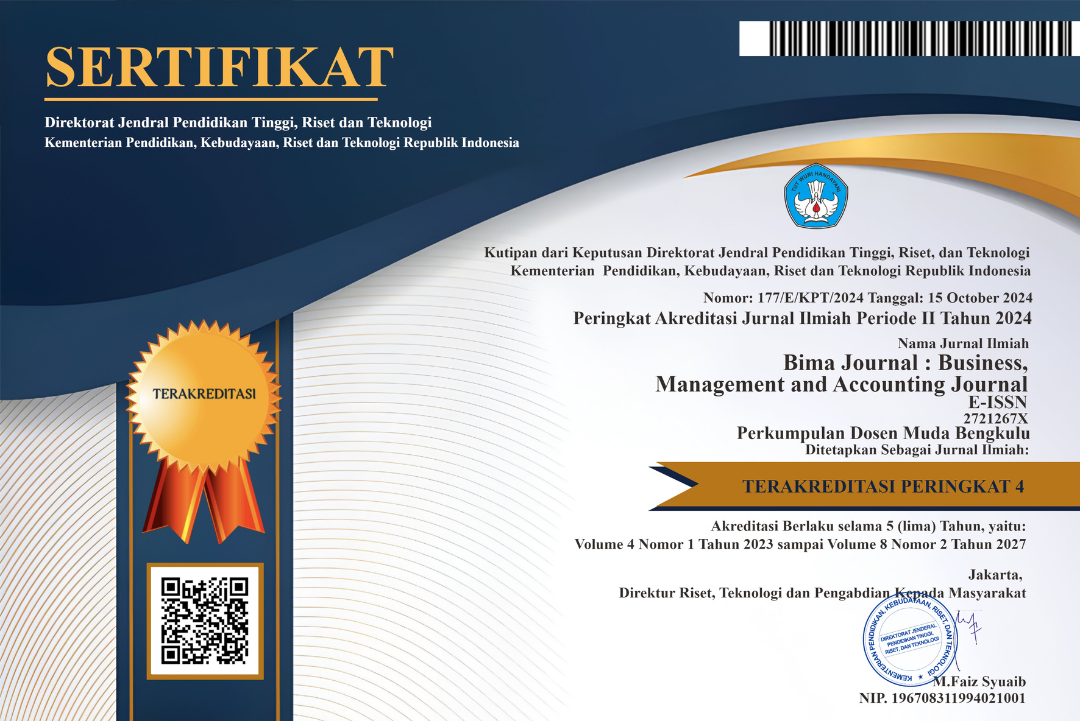
Bima Journal (Business, Management and Accounting Journal)
Publisher: Perkumpulan Dosen Muda (PDM) Bengkulu, Indonesia
Official Journal Website: https://journal.pdmbengkulu.org/index.php/bima
Bima Journal (Business, Management and Accounting Journal), published by Perkumpulan Dosen Muda (PDM) Bengkulu, Indonesia, is committed to maintaining high standards of research integrity, academic honesty, transparency, accountability, and ethical scholarly publishing.
The journal recognises that the credibility of scholarly publications depends on the originality, accuracy, reliability, and ethical conduct of research, as well as the integrity of editorial assessment and peer review.
Bima Journal takes all allegations of research and publication misconduct seriously and is committed to addressing them fairly, objectively, confidentially, proportionately, and without prejudice.
The journal's procedures are informed by the principles and relevant guidance of the Committee on Publication Ethics (COPE), including its guidance on cooperation between research institutions and journals and its guidelines on corrections, expressions of concern, and retractions.
This policy applies to all manuscripts submitted to or published in Bima Journal, including original research articles, review articles, conceptual papers, case study articles, and technical or methodological papers.
It also applies to the conduct of authors, co-authors, editors, editorial board members, peer reviewers, and other individuals participating in the journal's publication process.
The journal distinguishes between honest research errors, questionable research practices, and deliberate or reckless misconduct. Editorial responses must reflect the available evidence, the seriousness of the concern, and its implications for the reliability of the scholarly record.
The primary purpose of this policy is to protect the integrity of published research, ensure fair editorial procedures, and maintain confidence in scholarly communication in business, management, accounting, finance, economics, entrepreneurship, and related disciplines.
Research and publication misconduct may include, but is not limited to, the following practices.
Fabrication involves inventing research data, observations, findings, or evidence that were not obtained through genuine research activities.
Falsification involves manipulating research materials, processes, datasets, analytical procedures, or findings in a manner that misrepresents the research.
Examples include:
Inventing questionnaire responses or interview transcripts.
Fabricating organisational or financial performance data.
Altering accounting records or corporate financial information.
Manipulating survey responses to produce predetermined findings.
Misrepresenting statistical or econometric results.
Selectively excluding observations without legitimate methodological justification.
Reporting analytical findings that are inconsistent with the actual research data.
Legitimate data cleaning, justified statistical transformations, and appropriate methodological adjustments do not constitute misconduct when undertaken transparently and reported accurately.
Plagiarism includes presenting another person's ideas, arguments, data, text, research findings, conceptual models, or intellectual contributions as one's own without appropriate acknowledgement.
Misconduct may involve:
Unattributed copying of published or unpublished scholarly materials.
Improper paraphrasing without acknowledgement.
Unauthorised reproduction of tables, figures, or conceptual frameworks.
Misappropriation of confidential manuscripts or research proposals.
Presenting another researcher's theoretical development as an original contribution.
Textual similarity alone does not establish plagiarism. Suspected cases must be assessed through contextual examination of the relevant materials and supporting evidence.
Submitting or publishing substantially identical research in multiple journals without appropriate disclosure or justification may constitute publication misconduct.
This includes:
Simultaneous submission of the same manuscript to multiple journals.
Republishing substantially identical findings without appropriate acknowledgement.
Dividing a single research project into multiple minimally differentiated publications to increase publication counts.
Concealing substantial overlap with previously published work.
Reusing previously published datasets or analyses while misleading readers about their originality.
Legitimate secondary analyses, replication studies, extensions of previous research, and related publications may be considered when their contributions are clearly differentiated and relevant prior work is properly disclosed.
Authorship misconduct includes inappropriate inclusion, exclusion, attribution, or misrepresentation of individuals involved in research.
Examples include:
Gift or honorary authorship.
Guest authorship.
Undisclosed ghost authorship.
Excluding individuals who satisfy the journal's authorship criteria.
Listing individuals as authors without their consent.
Misrepresenting individual contributions.
Changing the order or composition of authors without the required agreement.
All authors must comply with the journal's Authorship Criteria and Author Contributions Policy.
Research misconduct may arise when researchers fail to observe applicable ethical requirements, institutional approvals, participant protections, or legal obligations.
Examples include:
Collecting personal information without appropriate ethical safeguards.
Conducting interviews or surveys without required informed consent.
Misusing confidential organisational records.
Disclosing commercially sensitive financial or business information without authorisation.
Failing to obtain required institutional or research ethics approval.
Misrepresenting participant recruitment procedures.
Breaching applicable data protection or confidentiality requirements.
The need for formal ethical approval must be assessed according to the research design, the nature of the data, applicable institutional requirements, and relevant legislation.
Peer-review manipulation refers to actions intended to improperly influence reviewer selection, evaluation, or editorial decisions.
Examples include:
Providing false reviewer identities or fabricated contact details.
Submitting fraudulent peer-review reports.
Establishing inappropriate reciprocal reviewing arrangements.
Attempting to influence reviewers through undisclosed personal or financial relationships.
Using confidential manuscript information for personal advantage.
Interfering with the independence of editorial assessment.
Participating in organised peer-review manipulation.
Editors and reviewers must comply with the journal's confidentiality, conflict-of-interest, and peer-review policies.
Citation manipulation includes practices designed to artificially influence citation metrics or misrepresent the scholarly evidence supporting a manuscript.
Examples include:
Inventing references or Digital Object Identifiers (DOIs).
Citing sources that do not support the statements attributed to them.
Including excessive irrelevant citations to increase citation counts.
Coercing authors to cite particular journals, editors, or researchers without scholarly justification.
Deliberately omitting essential contradictory literature to mislead readers.
Misrepresenting the findings of cited studies.
All references must be accurate, relevant, independently verifiable, and appropriately acknowledged.
The use of Generative Artificial Intelligence (GenAI) must comply with the journal's Policy on the Use of Generative Artificial Intelligence and AI-Assisted Technologies.
Potential misconduct includes:
Generating fabricated research data or interview responses.
Inventing references or bibliographic information.
Producing fictitious statistical or econometric findings.
Misrepresenting AI-generated content as independently verified evidence.
Concealing substantive AI involvement where disclosure is required.
Uploading confidential research data or unpublished manuscripts to unauthorised AI services.
Using AI to disguise plagiarism or manipulate academic evidence.
AI-assisted language editing or other permitted assistance does not constitute misconduct when conducted in accordance with the journal's disclosure, verification, and accountability requirements.
Authors, editors, and reviewers must disclose relevant financial and non-financial interests that could affect, or reasonably be perceived to affect, the integrity of research or publication decisions.
Potential misconduct includes concealing significant funding relationships, financial interests, consultancy arrangements, personal relationships, or institutional connections that materially compromise research transparency.
The existence of a conflict of interest does not automatically establish misconduct. Concerns must be evaluated according to their circumstances, materiality, disclosure requirements, and available evidence.
Other potential violations include:
Deliberate misrepresentation of research methods.
Unauthorised use of proprietary datasets.
Misleading presentation of financial or statistical results.
Misrepresentation of institutional affiliations.
Deliberate concealment of significant methodological limitations.
Interference with legitimate research integrity investigations.
Misappropriation of unpublished research materials.
Other serious breaches of recognised research and publication ethics.
Allegations of research or publication misconduct may be reported by authors, co-authors, reviewers, editors, readers, institutional representatives, research participants, or other concerned parties.
The journal welcomes concerns raised in good faith and supported by relevant information.
Reports should be submitted to the Editor-in-Chief of Bima Journal through the journal's official contact channel.
Where the allegation concerns the Editor-in-Chief, it should be referred to an independent senior editor or an appropriately designated representative of the publisher who is not involved in the matter.
Official Journal Website:
https://journal.pdmbengkulu.org/index.php/bima
Reports should include, where available:
The title and identifying information of the manuscript or published article.
A clear description of the alleged misconduct.
Relevant supporting evidence or documentation.
Identification of the specific content, data, references, or procedures in question.
Information concerning any previous investigation or communication about the matter.
Contact information for the complainant, where the complainant is willing to provide it.
Complainants are encouraged to present factual concerns rather than unsupported accusations.
Bima Journal may consider anonymous allegations where sufficiently specific, credible, and verifiable evidence is available.
Anonymous reports will not automatically be dismissed solely because the complainant's identity is unavailable.
However, allegations lacking identifiable evidence or a reasonable basis for assessment may be closed following preliminary review.
Individuals who report concerns in good faith should not be subjected to retaliation, intimidation, or discriminatory treatment by individuals acting on behalf of the journal.
Confidentiality will be maintained to the extent reasonably possible, subject to applicable legal obligations and the requirements of a fair investigation.
Knowingly false allegations made with malicious intent may themselves be considered an ethical concern, following an evidence-based assessment.
Bima Journal follows a structured, evidence-based approach informed by relevant COPE guidance.
The journal is responsible for assessing concerns affecting its editorial processes and publications. Research institutions or other competent bodies are generally better placed to conduct formal investigations into researchers' conduct, employment responsibilities, or institutional research practices.
Upon receiving an allegation, the Editor-in-Chief or an independent designated editor conducts a preliminary assessment.
The assessment determines:
Whether the concern falls within the journal's responsibilities.
Whether the allegation contains sufficiently specific information.
Whether supporting evidence is available.
Whether the concern could affect the reliability or integrity of a manuscript or publication.
Whether a conflict of interest requires independent handling.
Whether further clarification or institutional involvement is necessary.
The journal may seek preliminary advice from appropriate editorial or research integrity experts.
Relevant information may include:
Submitted manuscripts and published articles.
Research datasets and supporting documentation.
Survey instruments and interview records, where lawful and appropriate.
Statistical outputs and analytical procedures.
Relevant institutional approvals.
Editorial correspondence.
Similarity analysis reports.
Reference and DOI verification.
Other credible documentation relevant to the allegation.
Evidence must be evaluated in context.
Similarity scores, automated AI-detection results, statistical anomalies, or individual technical indicators must not be treated as conclusive evidence of misconduct without appropriate examination.
Where the allegation warrants further assessment, the individuals concerned should be informed of the material concerns and provided with a reasonable opportunity to respond.
Communications should:
Explain the nature of the concern in neutral language.
Identify the relevant evidence, subject to necessary confidentiality restrictions.
Request appropriate explanations or supporting documentation.
Specify a reasonable response deadline.
Explain any temporary editorial measures considered necessary.
The standard initial response period should normally be 14 calendar days, with reasonable extensions available where justified.
Failure to respond does not automatically establish misconduct, but it may affect the journal's ability to resolve concerns and may justify further action.
Where concerns arise during manuscript evaluation, the journal may temporarily suspend editorial processing until the matter has been sufficiently assessed.
Suspension is a precautionary measure and must not be treated as a finding of misconduct.
Where serious concerns arise after publication, the journal may consider appropriate interim measures, including an expression of concern, when justified by the available evidence and relevant ethical guidance.
Where specialist expertise is required, the journal may seek confidential advice from suitably qualified and independent experts.
Experts should possess relevant disciplinary, methodological, statistical, accounting, financial, or research integrity expertise.
They must disclose potential conflicts of interest and maintain appropriate confidentiality.
Where allegations concern matters requiring formal institutional investigation, the journal may contact the relevant university, research organisation, employer, funding body, or other competent authority.
The journal should provide appropriate supporting information while respecting confidentiality, legal restrictions, and procedural fairness.
Institutional findings should be considered when determining whether editorial corrections, retractions, or other publication-related measures are necessary.
The journal does not ordinarily act as an institutional disciplinary authority.
Editors, reviewers, or publisher representatives with a significant conflict of interest must not participate in decisions concerning the allegation.
Where the Editor-in-Chief is implicated or has a conflict of interest, responsibility must be assigned to an independent editor or appropriately constituted editorial panel.
The publisher may provide administrative and procedural support but must not improperly interfere with independent editorial judgement.
Following appropriate assessment, the authorised editor or independent editorial panel determines the necessary publication-related action.
Decisions must be based on:
The strength and credibility of the evidence.
The seriousness of the concern.
The response of the individuals involved.
Findings from any relevant institutional investigation.
The reliability of the research.
The implications for readers and the scholarly record.
Applicable journal policies and publication ethics guidance.
The decision and its supporting rationale should be documented.
The journal aims to handle allegations promptly while allowing sufficient time for fair assessment.
As recommended internal operational targets:
Receipt of an allegation should normally be acknowledged within seven working days.
Initial assessment should ordinarily be completed within 30 calendar days where sufficient information is available.
Individuals concerned should normally be given 14 calendar days to provide an initial response.
Complex investigations should be reviewed periodically until resolution.
These timeframes are targets rather than absolute deadlines. Cases involving institutional investigations, multiple parties, legal restrictions, or extensive evidence may require additional time.
Substantive delays and reasons for extending an investigation should be recorded.
Where an allegation is unsupported or adequately resolved, the journal may close the case with a documented explanation.
Relevant parties may request reconsideration where significant new evidence emerges or where a material procedural error is identified.
Any reconsideration should be assessed by an editor or panel that can exercise independent judgement.
Editorial actions must be proportionate to the evidence and the effect of the concern on the reliability of the scholarly record.
The journal may request further explanations, corrected information, supporting datasets, research instruments, institutional documentation, or relevant analytical records.
Where concerns can be resolved without compromising research integrity, authors may be required to revise the manuscript, correct errors, improve methodological transparency, or provide additional evidence.
Manuscript evaluation may be suspended while significant unresolved concerns are assessed.
The suspension should be reviewed periodically and lifted when the concerns have been adequately addressed.
A manuscript may be rejected where serious ethical violations are substantiated or where essential aspects of the research cannot be considered sufficiently reliable for publication.
A correction may be issued where an identifiable error affects part of a published article but does not fundamentally invalidate its principal findings or conclusions.
Corrections must clearly identify the affected article and explain the changes made.
An expression of concern may be considered where serious questions exist about a published article's reliability or integrity, but the available evidence is insufficient to justify retraction or an investigation remains unresolved.
Expressions of concern must be clearly identified, publicly accessible, and linked to the relevant published article.
A published article may be retracted where there is sufficient evidence that its findings or conclusions are seriously unreliable or that another substantial ground for retraction exists.
Retraction may be appropriate in cases involving fabrication, falsification, serious plagiarism, redundant publication, unethical research, or major errors that invalidate the article's conclusions.
Retraction is intended to correct the scholarly record rather than punish authors.
A retraction notice should:
Clearly identify the affected article.
State the reasons for retraction accurately.
Identify the party issuing the retraction.
Be publicly accessible.
Be linked to the original article.
Distinguish substantiated misconduct from honest error where the evidence permits.
Avoid unnecessary personal or defamatory statements.
Retracted articles should normally remain accessible with clear retraction labelling, except where exceptional legal, confidentiality, or ethical circumstances justify restricted access.
Where justified by the evidence, the journal may notify relevant research institutions, employers, funding organisations, or competent authorities.
Any communication must be factual, proportionate, and consistent with applicable confidentiality and data protection requirements.
In exceptional cases involving substantiated serious or repeated violations, the journal may consider proportionate restrictions on future submissions.
Such decisions must be documented, subject to appropriate editorial oversight, and communicated through a fair procedure.
Restrictions should not be imposed solely on the basis of unverified allegations.
Where corrections, expressions of concern, or retractions are issued, the journal should update relevant article landing pages, publication files, and DOI metadata where technically supported.
Editorial notices should be permanently accessible and clearly connected to the affected publications.
Bima Journal is committed to protecting the confidentiality of individuals involved in research misconduct allegations to the extent reasonably possible.
Information concerning allegations and investigations must be shared only with individuals who have a legitimate role in assessment, resolution, or legally required reporting.
An allegation does not, by itself, establish misconduct.
All parties must be treated fairly, objectively, and without premature judgement.
Individuals accused of misconduct must have a reasonable opportunity to respond to material concerns before a final adverse editorial decision is reached, except where immediate measures are necessary to comply with legal obligations or protect the scholarly record.
The journal does not tolerate retaliation against individuals who raise research integrity concerns in good faith.
The identities of complainants should be protected where appropriate and reasonably possible.
Individuals involved in an investigation must disclose relevant conflicts of interest.
Editors or reviewers with significant conflicts must withdraw from the assessment or decision-making process.
The journal should maintain appropriate records of allegations, correspondence, supporting evidence, editorial assessments, and final decisions.
Investigation records must be stored securely, with access restricted to authorised personnel and retention periods determined by applicable legal, institutional, and editorial requirements.
Confidential financial records, proprietary business datasets, participant information, personal data, and unpublished research materials must be handled securely.
The journal must not disclose restricted information unnecessarily during an investigation.
Use of external digital services, including GenAI platforms, must comply with the journal's confidentiality and data protection requirements.
Relevant individuals should be informed of editorial outcomes where appropriate and legally permissible.
Public statements must accurately describe the outcome of the editorial assessment and avoid unsupported allegations.
Bima Journal is committed to maintaining the reliability, transparency, credibility, and integrity of scholarly research in business, management, accounting, finance, economics, entrepreneurship, and related disciplines.
The journal promotes responsible research conduct through clear editorial policies, transparent authorship requirements, independent peer review, research ethics, appropriate data management, and proportionate responses to suspected misconduct.
Its editorial procedures are informed by relevant guidance from the Committee on Publication Ethics (COPE), including guidance concerning allegations of misconduct, cooperation with research institutions, corrections, expressions of concern, and retractions.
The journal recognises that responsible misconduct management requires both the protection of the scholarly record and fair treatment of all parties involved.
Authors remain responsible for the authenticity, accuracy, originality, and integrity of their research.
Editors are responsible for independent editorial decisions and appropriate management of publication-related concerns.
Reviewers are responsible for objective, confidential, and ethically conducted manuscript evaluations.
Perkumpulan Dosen Muda (PDM) Bengkulu, as the publisher, supports the implementation of responsible publication ethics policies while respecting editorial independence.
The Editorial Board will review this policy periodically to reflect developments in research integrity, scholarly publishing standards, responsible use of artificial intelligence, information security, and relevant legal requirements.
Substantive amendments will be communicated through the journal's official website following appropriate editorial approval.
Bima Journal (Business, Management and Accounting Journal) is committed to preventing, identifying, assessing, and appropriately addressing allegations of research and publication misconduct.
All allegations will be assessed through fair, impartial, confidential, and evidence-based editorial procedures informed by relevant COPE guidance.
The journal is committed to protecting the integrity of published research through appropriate editorial actions, including clarification, correction, expressions of concern, retraction, and cooperation with relevant research institutions where justified.
Editorial decisions will be based on scholarly integrity, verified evidence, procedural fairness, and the reliability of the academic record.
Policy Authority: Editorial Board of Bima Journal (Business, Management and Accounting Journal)
Publisher: Perkumpulan Dosen Muda (PDM) Bengkulu, Indonesia
Official Journal Website: https://journal.pdmbengkulu.org/index.php/bima
Reporting Channel: Editor-in-Chief, through the official journal contact page.
COLLABORATION
SCOPUS CITEDNESS
CITATION ANALYSIS
DOCUMENTS:
TOOLS
VISITOR:
KEYWORDS
DIRECT CHAT
BIMA Journal (Business, Management, & Accounting Journal)
P-ISSN: 2721-2971 (Print) dan E-ISSN: 2721-267X (Online)
DOI: https://doi.org/10.37638/bima
Published By:
Perkumpulan Dosen Muda (PDM) Bengkulu
Alamat : Asrama PDm Jalan Mangga 5 E Kelurahan Lingkar Timur Kota Bengkulu
Contact Us: 081328676033/ 082138129668
E-mail : parwitougm@gmail.com/ ekosumartono@relawanjurnal.id

This work is licensed under CC BY-SA 4.0


