

JOURNAL MENU
COLLABORATION


SCOPUS CITEDNESS

CITATION ANALYSIS


DOCUMENTS:

TOOLS


VISITOR:

KEYWORDS
DIRECT CHAT


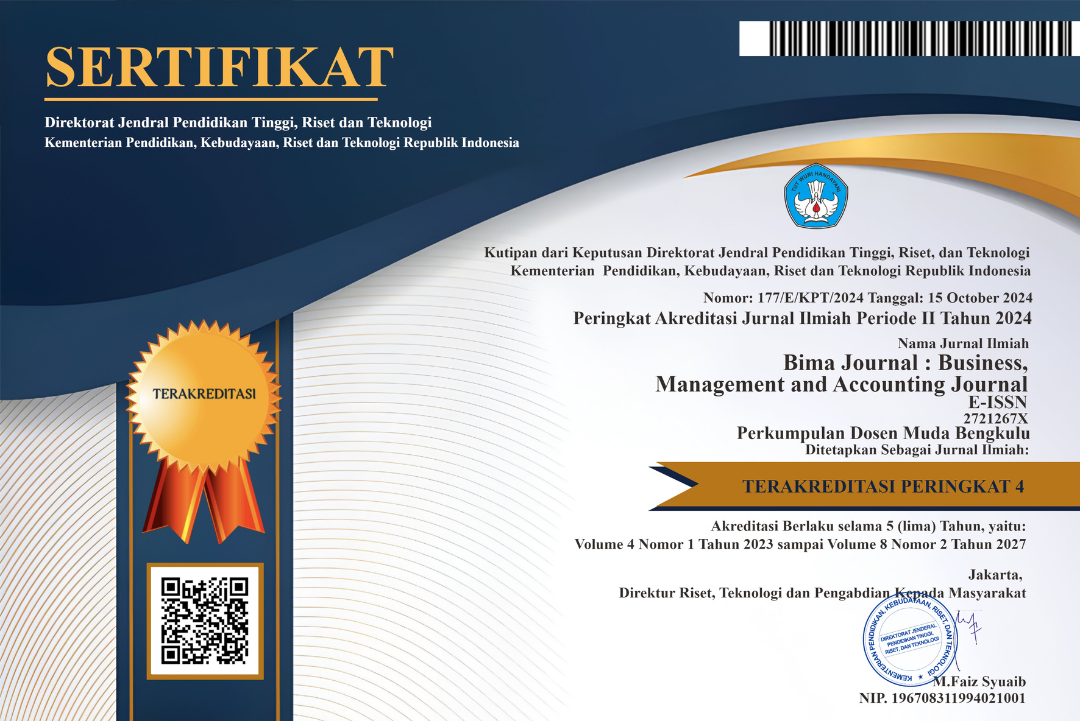
Bima Journal (Business, Management and Accounting Journal)
Publisher: Perkumpulan Dosen Muda (PDM) Bengkulu, Indonesia
Official Website: https://journal.pdmbengkulu.org/index.php/bima
Bima Journal (Business, Management and Accounting Journal) is an international, peer-reviewed, open-access scholarly journal published by Perkumpulan Dosen Muda (PDM) Bengkulu, Indonesia.
The journal provides an academic platform for disseminating original research, theoretical developments, methodological innovations, and evidence-based insights in business, management, accounting, finance, economics, entrepreneurship, and related disciplines.
Bima Journal welcomes contributions from researchers, academics, practitioners, policymakers, and professionals whose work advances scholarly knowledge and provides meaningful theoretical, methodological, managerial, or policy implications.
To ensure consistency, transparency, and scholarly quality, the journal establishes five recommended manuscript categories: Original Research Articles, Review Articles, Conceptual Papers, Case Study Articles, and Technical and Methodological Papers.
All submissions must demonstrate originality, scholarly relevance, methodological or conceptual rigour, appropriate use of evidence, and compliance with the journal's publication ethics and editorial policies.
Original Research Articles present new empirical findings derived from systematic and methodologically rigorous investigations.
Manuscripts must address clearly formulated research questions, identify relevant gaps in existing knowledge, and contribute meaningful theoretical, empirical, methodological, or practical insights.
The journal welcomes quantitative, qualitative, mixed-methods, experimental, survey-based, archival, and longitudinal research.
Relevant research areas include:
Strategic management, organisational performance, and competitive advantage.
Marketing management, consumer behaviour, and digital marketing.
Financial management, corporate finance, and investment decisions.
Financial accounting, management accounting, and auditing.
Taxation, public sector accounting, and corporate governance.
Human resource management, leadership, and organisational behaviour.
Entrepreneurship, innovation, and small business development.
Digital transformation, e-commerce, and financial technology.
Business economics, financial markets, and banking.
Sustainability accounting, ESG disclosure, and responsible business practices.
Original Research Articles should generally include:
Title and author information.
Abstract and keywords.
Introduction, research problem, and knowledge gap.
Literature Review and Hypothesis Development, where applicable.
Research Methods.
Results.
Discussion.
Theoretical and Practical Implications.
Research Limitations and Future Research Directions.
Conclusions.
Required ethical and transparency declarations.
References.
The precise section structure may be adapted to qualitative, quantitative, or mixed-methods research.
Original Research Articles must:
Identify a clear research problem and demonstrate its significance.
Establish a convincing research gap supported by relevant literature.
Explain the theoretical or conceptual foundations of the study.
Describe the research design, sampling, data sources, instruments, and analytical procedures transparently.
Apply appropriate statistical, econometric, qualitative, or other recognised analytical methods.
Report authentic findings without selective or misleading presentation.
Discuss findings critically in relation to previous research.
Distinguish statistical significance from practical and theoretical significance where relevant.
Acknowledge methodological limitations.
Draw conclusions consistent with the evidence.
Manuscripts using structural equation modelling, regression analysis, panel data, experiments, or other analytical techniques must provide adequate information to evaluate the validity, robustness, and reproducibility of the results.
Review Articles critically examine, synthesise, and evaluate existing scholarly literature to advance theoretical understanding, identify research gaps, assess accumulated evidence, or propose future research directions.
Bima Journal welcomes rigorous systematic literature reviews, critical or integrative reviews, bibliometric analyses, and meta-analyses relevant to business, management, accounting, finance, and related disciplines.
Review Articles must provide intellectual contributions beyond descriptive summaries of previous publications.
Relevant topics include:
Systematic reviews of corporate governance and firm performance.
Meta-analyses of leadership and organisational performance.
Bibliometric analyses of sustainability accounting and ESG research.
Reviews of digital transformation and business innovation.
Evidence synthesis concerning entrepreneurship and SME development.
Critical reviews of financial reporting quality and auditing.
Integrative reviews of consumer behaviour and digital marketing.
Reviews of fintech adoption and financial inclusion.
Review Articles should generally include:
Title and author information.
Abstract and keywords.
Introduction and review objectives.
Review Questions and Scope.
Review Methodology.
Literature Identification and Selection.
Results or Evidence Synthesis.
Critical Discussion.
Theoretical, Managerial, or Policy Implications.
Research Gaps and Future Research Agenda.
Limitations.
Conclusions.
Required declarations.
References.
Systematic reviews and meta-analyses must describe their information sources, search strategies, eligibility criteria, screening procedures, quality appraisal where appropriate, and evidence synthesis methods sufficiently for readers to evaluate the review process.
Authors should follow recognised reporting guidance, including PRISMA 2020 where applicable.
Bibliometric studies must report the databases searched, search strings, retrieval dates, inclusion and exclusion criteria, data-cleaning procedures, analytical software, and interpretation methods.
Critical and integrative reviews must explain their conceptual boundaries, literature selection rationale, analytical approach, and theoretical contribution.
A bibliometric analysis consisting solely of publication counts, citation rankings, keyword maps, or descriptive visualisations without meaningful scholarly interpretation is insufficient.
Review Articles must identify substantive research gaps, synthesise knowledge critically, and provide clear contributions to the relevant discipline.
Conceptual Papers develop original theoretical arguments, conceptual models, propositions, or analytical frameworks that advance scholarly understanding of business, management, accounting, and related fields.
Unlike empirical research articles, Conceptual Papers primarily develop theoretical contributions through critical reasoning, conceptual integration, and rigorous engagement with existing literature.
Manuscripts must go beyond descriptive literature summaries and demonstrate a clearly articulated contribution to theoretical knowledge.
Relevant contributions may include:
New conceptual frameworks for corporate governance effectiveness.
Theoretical models of sustainable business performance.
Conceptual integration of dynamic capabilities and organisational resilience.
New perspectives on management control and accountability.
Frameworks for ethical leadership and responsible business conduct.
Conceptual models of digital entrepreneurship and innovation.
Theoretical developments in sustainability reporting and ESG governance.
Integrative frameworks for strategic performance measurement.
Conceptual Papers should generally include:
Title and author information.
Abstract and keywords.
Introduction.
Conceptual Problem and Research Gap.
Theoretical Foundations.
Critical Analysis and Theoretical Integration.
Proposed Conceptual Framework or Propositions.
Theoretical Contributions.
Managerial or Policy Implications.
Limitations and Future Research Directions.
Conclusions.
Required declarations.
References.
Conceptual Papers must:
Identify a meaningful theoretical problem or unresolved conceptual issue.
Demonstrate familiarity with relevant foundational and contemporary scholarship.
Critically integrate theories, concepts, or competing perspectives.
Develop logically coherent arguments.
Clearly explain what is theoretically new.
Present propositions, relationships, or conceptual frameworks where appropriate.
Distinguish proposed theoretical contributions from established empirical findings.
Identify relevant opportunities for future theoretical development or empirical testing.
Manuscripts that merely summarise existing theories or reproduce established conceptual models without meaningful advancement may be rejected.
Case Study Articles present systematic, evidence-based investigations of organisations, enterprises, business practices, managerial decisions, accounting systems, financial processes, institutional arrangements, or other relevant real-world phenomena.
The category accommodates single-case and multiple-case research using qualitative, quantitative, or mixed-methods approaches.
Case Study Articles must generate meaningful analytical insights, contribute to theoretical understanding, or provide transferable managerial and policy lessons.
Routine organisational descriptions, consultancy reports, and promotional accounts are not sufficient.
Relevant cases include:
Corporate restructuring and strategic transformation.
Implementation of management accounting systems.
Financial governance and accountability within public institutions.
Digital transformation in micro-, small-, and medium-sized enterprises.
Business model innovation and entrepreneurial development.
Corporate sustainability and environmental management practices.
Risk management and internal control implementation.
Leadership, organisational change, and human resource management.
Marketing strategy and competitive positioning.
Financial reporting, audit practices, and organisational accountability.
Case Study Articles should generally include:
Title and author information.
Abstract and keywords.
Introduction.
Case Background and Research Context.
Research Questions and Theoretical Foundations.
Case Study Methodology.
Data Sources and Analytical Procedures.
Case Findings.
Discussion and Theoretical Interpretation.
Managerial or Policy Implications.
Limitations and Transferability.
Conclusions.
Required declarations.
References.
Case Study Articles must:
Present an identifiable and academically relevant case.
Explain the case selection rationale and research context.
State clear research questions or analytical objectives.
Describe data collection and analysis procedures transparently.
Support findings through credible evidence such as interviews, observations, financial records, organisational documents, or relevant datasets.
Explain triangulation or other measures of research trustworthiness where appropriate.
Analyse findings in relation to relevant theories or scholarly literature.
Discuss contextual limitations and transferability.
Protect confidential organisational and participant information.
Hypothetical teaching cases may be considered only under a separately approved educational case category and must not be presented as empirical research findings.
Technical and Methodological Papers present the development, adaptation, testing, validation, or critical evaluation of analytical methods, digital systems, measurement instruments, decision-support tools, and technical innovations relevant to business, management, accounting, or finance.
This category replaces an exclusively technology-oriented interpretation of Technical Papers with a discipline-specific approach emphasising methodological originality, analytical reliability, reproducibility, and practical relevance.
Manuscripts must demonstrate a substantive methodological or scholarly contribution rather than merely describing a software application, product, or business service.
Relevant topics include:
Development and validation of business performance measurement instruments.
Accounting information systems and digital reporting applications.
Business analytics and managerial decision-support models.
Financial forecasting and risk assessment methods.
Machine learning applications in auditing and financial analysis.
Digital internal control and fraud detection systems.
Supply-chain optimisation and operations analytics.
Measurement model development in organisational and management research.
Analytical frameworks for corporate sustainability reporting.
Computational methods for business and financial decision-making.
Technical and Methodological Papers should generally include:
Title and author information.
Abstract and keywords.
Introduction and Methodological Problem.
Literature and Existing Methodological Approaches.
Objectives and Proposed Innovation.
Method or System Development.
Data, Instruments, and Evaluation Procedures.
Validation, Benchmarking, or Performance Assessment.
Results and Discussion.
Methodological and Practical Implications.
Limitations.
Conclusions.
Required declarations.
References.
Technical and Methodological Papers must:
Identify a clearly defined methodological or technical problem.
Explain the novelty or added value of the proposed approach.
Describe methods, models, algorithms, instruments, or procedures accurately.
Provide appropriate validation or performance assessment.
Compare the proposed approach with suitable existing methods or benchmarks where feasible.
Explain assumptions, limitations, and conditions affecting applicability.
Provide sufficient methodological detail for independent evaluation.
Support conclusions with credible analytical or empirical evidence.
Manuscripts presenting commercial software, management applications, or consultancy tools without adequate methodological evaluation or scholarly contribution will not be accepted.
All manuscripts submitted to Bima Journal must comply with the journal's official Author Guidelines, manuscript template, and publication ethics policies.
The journal accepts manuscripts written in Indonesian or English, in accordance with its current Author Guidelines.
English-language manuscripts should use clear, consistent, and academically appropriate English. British English is preferred for consistency in editorial presentation.
Authors must ensure that technical terminology, analytical explanations, and scholarly arguments are accurate and understandable.
Under the journal's current Author Guidelines, manuscripts must not exceed 14 pages, including references and relevant attachments incorporated into the main document.
This requirement applies unless an alternative length has been formally approved and published by the Editorial Board.
The journal may subsequently establish separate length requirements for different manuscript categories, particularly comprehensive systematic reviews or methodological papers.
Manuscripts must include an informative abstract of 100–250 words, consistent with the journal's current guidelines.
The abstract should identify the research problem or objective, methodological approach, principal findings or arguments, and main conclusions.
Abstract language requirements must follow the journal's official Author Guidelines.
Authors should provide relevant and specific keywords that improve scholarly discoverability and indexing.
All tables, figures, conceptual models, diagrams, and illustrations must be clearly numbered, appropriately titled, and cited within the manuscript.
Visual materials must accurately represent underlying evidence.
Authors must not manipulate financial figures, statistical outputs, datasets, or graphical representations in a manner that misleads readers.
All manuscripts must include relevant, accurate, and verifiable scholarly references.
References must be formatted consistently according to the journal's officially adopted referencing style.
Authors should prioritise relevant peer-reviewed research, foundational theoretical sources, and credible scholarly publications.
References must be directly relevant to the arguments or findings presented.
Fabricated citations, invented Digital Object Identifiers (DOIs), misleading bibliographic information, and inappropriate citation manipulation are prohibited.
Where applicable, submissions must include declarations concerning:
Research ethics approval and informed consent.
Conflicts of interest.
Funding sources.
Author contributions using CRediT.
Data availability and access restrictions.
The use of Generative Artificial Intelligence.
Permissions for third-party materials.
Organisational confidentiality and personal data protection.
Authors remain responsible for the accuracy, originality, validity, and integrity of their manuscripts.
Authors must select the manuscript category that best represents the scholarly purpose, methodology, and principal contribution of their submission.
Manuscripts should be submitted through the official Bima Journal Open Journal Systems (OJS) platform, subject to the submission procedures published by the journal.
Authors must provide accurate article metadata, author information, affiliations, and required declarations.
The editorial team may request clarification or recommend reclassification when a manuscript is submitted under an inappropriate category.
Reclassification does not guarantee acceptance and does not exempt manuscripts from editorial assessment or peer review.
All manuscripts undergo initial editorial screening to determine their relevance, originality, scholarly contribution, methodological or conceptual quality, and compliance with the journal's submission requirements.
Manuscripts meeting the initial editorial criteria proceed to independent peer review in accordance with the journal's double-blind peer-review policy.
Reviewers assess manuscripts using criteria appropriate to their categories.
Original Research Articles are assessed for research originality, methodological validity, analytical reliability, theoretical contribution, and implications.
Review Articles are assessed for the rigour of their review methods, critical synthesis, transparency, originality of interpretation, and contribution to knowledge.
Conceptual Papers are assessed for theoretical originality, analytical depth, logical coherence, conceptual integration, and scholarly significance.
Case Study Articles are assessed for case relevance, evidence quality, methodological transparency, analytical depth, and theoretical or practical contributions.
Technical and Methodological Papers are assessed for methodological innovation, validity, reproducibility, appropriate benchmarking, and practical relevance.
Final editorial decisions must be based on scholarly merit, independent peer-review evaluations, ethical compliance, and relevance to the journal's aims and scope.
Manuscript acceptance must not be determined by institutional affiliation, nationality, personal relationships, or financial considerations.
Bima Journal does not accept manuscripts that:
Fall outside the journal's stated aims and scope.
Have previously been published or are simultaneously under consideration elsewhere without an applicable and properly disclosed exception.
Lack sufficient originality or meaningful scholarly contribution.
Present fabricated, falsified, manipulated, or unverifiable evidence.
Contain plagiarism or serious breaches of publication ethics.
Make unsupported empirical, methodological, theoretical, or managerial claims.
Consist primarily of commercial advertisements, promotional materials, or consultancy reports.
Describe routine organisational activities without systematic scholarly analysis.
Misrepresent research methods, data sources, authorship, or analytical findings.
Fail to comply with the journal's minimum scholarly and editorial requirements.
Manuscripts that do not satisfy these requirements may be declined during initial editorial screening or rejected following peer review.
Bima Journal should implement its manuscript classification policy by:
Publishing the approved manuscript types on the official journal website.
Incorporating category-specific requirements into the Author Guidelines.
Configuring corresponding article sections within OJS.
Providing an official manuscript template and relevant preparation instructions.
Verifying manuscript classification during initial editorial screening.
Assigning manuscripts to reviewers with relevant disciplinary and methodological expertise.
Applying category-specific scholarly evaluation criteria.
Maintaining accurate article-type and publication metadata.
Recording relevant editorial decisions and manuscript reclassifications.
Periodically reviewing article categories to reflect developments in business, management, accounting, and related research fields.
Any new manuscript category must be formally approved before implementation in the journal's submission system.
The Editorial Board of Bima Journal (Business, Management and Accounting Journal), in coordination with Perkumpulan Dosen Muda (PDM) Bengkulu, will periodically review this policy to maintain its relevance, transparency, consistency, and alignment with recognised scholarly publishing practices.
Reviews will consider developments in research methodologies, academic publishing standards, publication ethics, digital research technologies, and emerging areas of business, management, accounting, and finance.
Any approved amendments to manuscript types, submission requirements, or editorial procedures will be communicated through the journal's official website.
Bima Journal (Business, Management and Accounting Journal) welcomes original scholarly contributions through the following recommended manuscript categories:
Original Research Article.
Review Article.
Conceptual Paper.
Case Study Article.
Technical and Methodological Paper.
All manuscripts must demonstrate scholarly relevance, originality, appropriate methodological or conceptual rigour, transparent reporting, meaningful contributions to knowledge, and compliance with the journal's publication ethics requirements.
The journal is committed to maintaining consistent editorial standards, promoting academic integrity, and supporting the responsible dissemination of research in business, management, accounting, finance, economics, entrepreneurship, and related disciplines.
Policy Authority: Editorial Board of Bima Journal (Business, Management and Accounting Journal)
Publisher: Perkumpulan Dosen Muda (PDM) Bengkulu, Indonesia
Official Journal Website: https://journal.pdmbengkulu.org/index.php/bima
JOURNAL MENU
COLLABORATION
SCOPUS CITEDNESS
CITATION ANALYSIS
DOCUMENTS:
TOOLS
VISITOR:
KEYWORDS
DIRECT CHAT
BIMA Journal (Business, Management, & Accounting Journal)
P-ISSN: 2721-2971 (Print) dan E-ISSN: 2721-267X (Online)
DOI: https://doi.org/10.37638/bima
Published By:
Perkumpulan Dosen Muda (PDM) Bengkulu
Alamat : Asrama PDm Jalan Mangga 5 E Kelurahan Lingkar Timur Kota Bengkulu
Contact Us: 081328676033/ 082138129668
E-mail : parwitougm@gmail.com/ ekosumartono@relawanjurnal.id

This work is licensed under CC BY-SA 4.0


