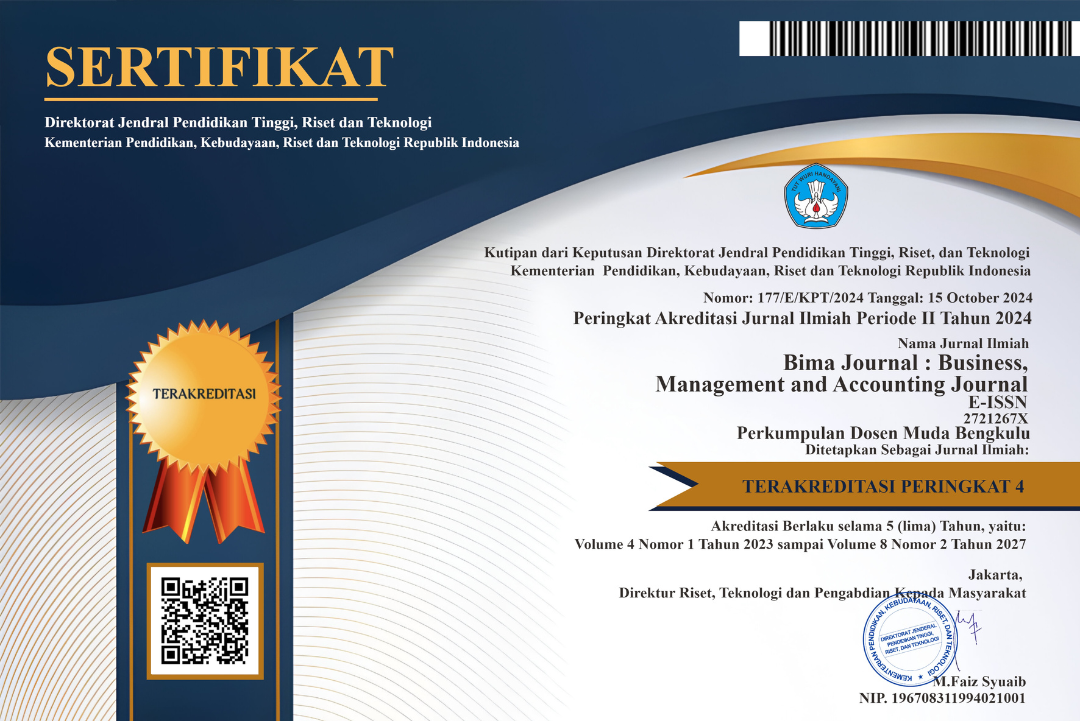
Role Of Digital Competence, Digital Culture, Individual Experience, In Increasing Job Satisfaction And Employee Performance At Bumn Banks In Palopo City
DOI:
https://doi.org/10.37638/bima.6.1.627-642Abstract
Purpose: This study aims to analyze the effect of digital competence, digital culture, and individual experience on job satisfaction and employee performance at the Palopo City BUMN Bank. Methodology: A quantitative approach was employed using Partial Least Squares-Structural Equation Modeling (PLS-SEM) to analyze the data. Results: The findings indicate that digital competence has a significant effect on employee performance but does not significantly affect job satisfaction. Digital culture, however, has a significant positive effect on both job satisfaction and employee performance. Additionally, individual experience has a significant positive effect on both job satisfaction and employee performance. Findings: The study reveals that digital culture and individual experience are key factors that enhance both job satisfaction and employee performance, while digital competence primarily influences performance. Novelty: The novelty of this research lies in the integration of digital competence, culture, and individual experience in the banking sector, an area that has not received much attention in previous studies. Originality: This study is original in its focus on the banking sector and its contribution to understanding the role of digital factors in employee performance and job satisfaction. Conclusions: The study suggests developing digital competency training programs and fostering an inclusive digital culture to improve organizational performance. Type of Paper: Research paper.
References
Ajaelu, H., & Okereke, R. A. (2022). Nigerian institute of quantity surveyors : Theme : Confluence of Research , Theory and Practice in the Built Environment Editors : (Issue March).
Arabia, S. (2020). Job Satisfaction: Analysis of the Institute of Public Administration. International Journal of Managerial Studies and Research, 8(12), 80–83. https://doi.org/10.20431/2349-0349.0812008
Ardi, Djati, S. P., Bernarto, I., Sudibjo, N., Yulianeu, A., Nanda, H. A., & Nanda, K. A. (2020). The relationship between digital transformational leadership styles and knowledge-based empowering interaction for increasing organisational innovativeness. International Journal of Innovation, Creativity and Change, 11(3), 259–277.
Audrin, C., & Audrin, B. (2023). More than just emotional intelligence online: introducing “digital emotional intelligence.†Frontiers in Psychology, 14(1). https://doi.org/10.3389/fpsyg.2023.1154355
Bahida, H., Ziky, R., Charef, F., Bouzahir, B., Abriane, A., & Boukaya, L. (2023). Exploring factors and the role of environmental responsibility in m-banking adoption: a systematic review. E3S Web of Conferences, 412. https://doi.org/10.1051/e3sconf/202341201004
Editors, A., & Board, E. R. (2020). Professionals Interna tional Journal of Human Capital and Information Technology Call for Articles International Journal of Human Capital and Information Technology (Vol. 11, Issue 1).
Fornell, C., & Larcker, David, F. (1981). Fornell, C., & Larcker, D. F. (1981). Evaluating Structural Equation Models with Unobservable Variables and Measurement Error. Journal of Marketing Research, 18(1), 39–50.
Glazunova, O., Saiapina, T., Korolchuk, V., Kasatkina, O., & Voloshyna, T. (2021). Digital intelligence of a modern economist: an exploratory case study. SHS Web of Conferences, 104, 03001. https://doi.org/10.1051/shsconf/202110403001
Hai, T. N., Van, Q. N., & Tuyet, M. N. T. (2021). Digital transformation: Opportunities and challenges for leaders in the emerging countries in response to covid-19 pandemic. Emerging Science Journal, 5(Special Issue), 21–36. https://doi.org/10.28991/esj-2021-SPER-03
Hajiali, I., Fara Kessi, A. M., Budiandriani, B., Prihatin, E., Sufri, M. M., & Sudirman, A. (2022). Determination of Work Motivation, Leadership Style, Employee Competence on Job Satisfaction and Employee Performance. Golden Ratio of Human Resource Management, 2(1),
–69. https://doi.org/10.52970/grhrm.v2i1.160
Hakuduwal, K. (2021). Factors Affecting Employee Job Satisfaction in Nepalese Hospitality Industry: A Study of Hotels in Bhaktapur. Nepalese Journal of Hospitality and Tourism Management, 2(1), 14–26. https://doi.org/10.3126/njhtm.v2i1.44392
Halid, H., Yusoff, Y. M., & Somu, H. (2020). The Relationship Between Digital Human Resource Management and Organizational Performance. 141, 96–99. https://doi.org/10.2991/aebmr.k.200514.022
Hamid, R. S., Abror, A., Anwar, S. M., & Hartati, A. (2022). The role of social media in the political involvement of millennials. Spanish Journal of Marketing - ESIC, 26(1), 61–79. https://doi.org/10.1108/SJME-08-2021-0151
Hassan, M. K., Halliru, M., & Maiyaki, A. A. (2023). Afropolitan Journals Mediating Effect of Employees ’ Psychological Well-Being on the Relationship between Leadership Style and Organisational Citizenship Behaviour in Health Institutions : A Pilot Study Afropolitan Journals. 10(1), 228–241.
Henseler, J., Ringle, C. M., & Sarstedt, M. (2015). A new criterion for assessing discriminant validity in variance-based structural equation modeling. Journal of the Academy of Marketing Science, 43(1), 115–135. https://doi.org/10.1007/s11747-014-0403-8
Huu, P. T. (2023). Impact of employee digital competence on the relationship between digital autonomy and innovative work behavior: a systematic review. Artificial Intelligence Review, 56(12), 14193–14222. https://doi.org/10.1007/s10462-023-10492-6
James, K., Betty, N., Thaddeo, M. J., & Kirabira, J. B. (2024). Blood production factors affecting transfusion sustainability: A study by using smart PLS-SEM approach. Journal of Open Innovation: Technology, Market, and Complexity, 10(1), 100247. https://doi.org/10.1016/j.joitmc.2024.100247
Javaid, M., Haleem, A., Singh, R. P., & Sinha, A. K. (2024). Digital economy to improve the culture of industry 4.0: A study on features, implementation and challenges. Green Technologies and Sustainability, 2(2), 100083. https://doi.org/10.1016/j.grets.2024.100083
Karsenti, T., Poellhuber, B., Parent, S., & Michelot, F. (2020). What is the Digital Competency Framework? Revue Internationale Des Technologies En Pédagogie Universitaire, 17(1), 11–14. https://doi.org/10.18162/ritpu-2020-v17n1-04
Kurniawan, A., Rahayu, A., & Wibowo, L. A. (2021). Pengaruh Transformasi Digital Terhadap Kinerja Bank Pembangunan Daerah Di Indonesia. Jurnal Ilmu Keuangan Dan Perbankan (JIKA), 10(2), 158–181. https://doi.org/10.34010/jika.v10i2.4426
Lehmann, J., & Beckmann, M. (2024). Digital technologies and performance incentives: Evidence from businesses in the Swiss economy. http://arxiv.org/abs/2412.12780
Megawati, M., Hamdat, A., & Aida, N. (2022). Examining Linkage Leadership Style, Employee Commitment, Work Motivation, Work Climate on Satisfaction and Performance. Golden Ratio of Human Resource Management, 2(1), 01–14. https://doi.org/10.52970/grhrm.v2i1.86
Milenkova, V., Manov, B., Literacy, D., & Competence, D. (2019). Digital Competences and Skills in the Frame of Education and Training. 2019 2nd International Conference on Contemporary Education and Economic Development (CEED 2019), 17(Ceed), 5–10. https://doi.org/10.23977/ceed.2019.002
Murawski, M., Darvish, M., Prinz, C. M., & Bick, M. (2020). Exploring Digital Competence Requirements for Junior Financial Analysts in the UK Banking Industry. In Lecture Notes in Computer Science (including subseries Lecture Notes in Artificial Intelligence and Lecture Notes in Bioinformatics): Vol. 12067 LNCS. Springer International Publishing. https://doi.org/10.1007/978-3-030-45002-1_31
Negi, P. S., & Dangwal, R. C. (2024). Identifying the aspects of organizational culture: a study of Indian banking industry. PSU Research Review, 8(1), 41–50. https://doi.org/10.1108/PRR-03-2021-0017
Nguyen, T. T., Nguyen, H. T., Mai, H. T., & Tran, T. T. M. (2020). Determinants of digital banking services in Vietnam: Applying utaut2 model. Asian Economic and Financial Review, 10(6), 680–697. https://doi.org/10.18488/journal.aefr.2020.106.680.697
Periáñez-Cañadillas, I., Charterina, J., & Pando-GarcÃa, J. (2019). Assessing the relevance of digital competences on business graduates’ suitability for a job. Industrial and Commercial Training, 51(3), 139–151. https://doi.org/10.1108/ICT-09-2018-0076
Purwaningsih, D., Yuniarsih, T., Disman, & Sojanah, J. (2021). The Effect of Talent Management on the Performance of Educational Employee in Higher Education Institutions. Proceedings of the 5th Global Conference on Business, Management and Entrepreneurship (GCBME 2020), 187(Gcbme 2020), 201–204.
https://doi.org/10.2991/aebmr.k.210831.040
Rahiem, M. D. H., & Rahim, H. (2021). Cquniversity research. Journal of Ethnic and Cultural Studies, 8(1), 43–65. https://doi.org/10.1108/ITP-01-2021-0013/full/html
Rambousek, V., FuglÃk, V., & Å tÃpek, J. (2015). Selected outcomes of research of digital competency development on elementary schools. Journal on Efficiency and Responsibility in Education and Science, 8(2), 35–43. https://doi.org/10.7160/eriesj.2015.080201.
Ratna Pudyaningsih, A., Dwiharto, J., & Ghifary, M. T. (2020). The role of work satisfaction as a mediation leadership on employee performance. Management Science Letters, 10(16), 3735–3740. https://doi.org/10.5267/j.msl.2020.7.039
Rimal, I. (2022). Job Satisfaction among Technical and Vocational Education and Training (TVET) Schools Employees in Kathmandu. Nepal Journal of Multidisciplinary Research, 5(4), 52–65. https://doi.org/10.3126/njmr.v5i4.49780
Sanusi, I. T., Olaleye, S. A., Oyelere, S. S., & Dixon, R. A. (2022). Investigating learners’ competencies for artificial intelligence education in an African K-12 setting. Computers and Education Open, 3(March), 100083. https://doi.org/10.1016/j.caeo.2022.100083
Septiatin, A., Pajaria, Y., Zuhro, F., & Rosyada, R. (2022). The Effect Of The Work Environment, Locus Of Control And Motivation On Employees Performance In Baznas Of South Sumatra Province. Jurnal I-Philanthropy: A Research Journal On Management Of Zakat and
Waqf, 2(1), 22–40. https://doi.org/10.19109/iphi.v2i1.12079
Srivastava, S., & Dangwal, K. L. (2021). Digital Competence: Where do the Higher Education Teachers Stand? Universal Journal of Educational Research, 9(10), 1765–1772. https://doi.org/10.13189/ujer.2021.091005
Tafese Keltu, T. (2024). The effect of human resource development practice on employee performance with the mediating role of job satisfaction among Mizan Tepi University’s academic staff in Southwestern Ethiopia. Heliyon, 10(8), e29821. https://doi.org/10.1016/j.heliyon.2024.e29821
Walsh, T. (2019). Virtual Team Success with the Power of Technology Advancements. In P. A. Gordon & J. A. Overbey (Eds.), Advances in the Technology of Managing People: Contemporary Issues in Business (pp. 99–107). Emerald Publishing Limited. https://doi.org/10.1108/978-1-78973-073-920191009
Yafi, E., Tehseen, S., & Haider, S. A. (2021). Impact of green training on environmental performance through mediating role of competencies and motivation. Sustainability (Switzerland), 13(10), 1–15. https://doi.org/10.3390/su13105624
Yanchovska, I. (2021). La relación entre la satisfacción laboral y el desempeño individual de los empleados de tecnologÃa de la información. Actas Del Centro de Bienestar Universitario En EconomÃa y Negocios, 2, 141–148. https://ojs.cbuic.cz/index.php/peb/article/view/267
Zhang, J., & Chen, Z. (2024). Exploring Human Resource Management Digital Transformation in the Digital Age. Journal of the Knowledge Economy, 15(1), 1482–1498. https://doi.org/10.1007/s13132-023-01214-y
Downloads
Published
Issue
Section
License
An author who publishes in the BIMA JOURNAL: Business, Management, and Accounting Journal agrees to the following terms:
Author retains the copyright and grants the journal the right of first publication of the work simultaneously licensed under the Creative Commons Attribution-ShareAlike 4.0 License that allows others to share the work with an acknowledgement of the work's authorship and initial publication in this journal
Submission of a manuscript implies that the submitted work has not been published before (except as part of a thesis or report, or abstract); that it is not under consideration for publication elsewhere; that its publication has been approved by all co-authors. If and when the manuscript is accepted for publication, the author(s) still hold the copyright and retain publishing rights without restrictions. For the new invention, authors are suggested to manage its patent before published. The license type is CC-BY-SA 4.0.
BIMA JOURNAL: Business, Management and Accounting is licensed under a Creative Commons Attribution-ShareAlike 4.0 International License.
You are free to:
Share — copy and redistribute the material in any medium or format
Adapt — remix, transform, and build upon the material
for any purpose, even commercially.
The licensor cannot revoke these freedoms as long as you follow the license terms.
Under the following terms:
Attribution — You must give appropriate credit, provide a link to the license, and indicate if changes were made. You may do so in any reasonable manner, but not in any way that suggests the licensor endorses you or your use.
ShareAlike — If you remix, transform, or build upon the material, you must distribute your contributions under the same license as the original.
- No additional restrictions — You may not apply legal terms or technological measures that legally restrict others from doing anything the license permits.
Notices:
- You do not have to comply with the license for elements of the material in the public domain or where your use is permitted by an applicable exception or limitation.
- No warranties are given. The license may not give you all of the permissions necessary for your intended use. For example, other rights such as publicity, privacy, or moral rights may limit how you use the material.
How to Cite