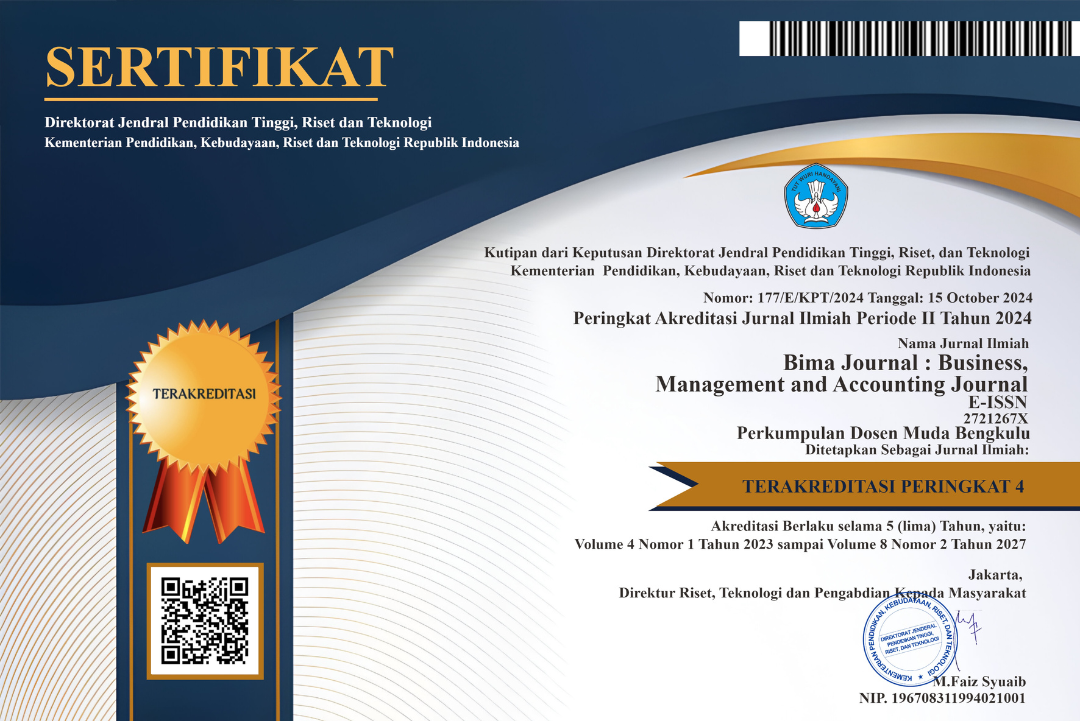
Impact of Product Differentiation, Culture, and E-Commerce Knowledge on Trust and Intention to Use E-Commerce among MSMEs
DOI:
https://doi.org/10.37638/bima.6.1.701-716Abstract
Purpose : This study explores the effect of product differentiation, culture, and e-commerce knowledge on trust and intention to use e-commerce among MSMEs in Palopo City. Methodology: It employs a quantitative approach using questionnaires, with data analyzed through Partial Least Squares Structural Equation Modeling (PLS-SEM). Results: show that product differentiation and e-commerce knowledge have a significant positive effect on trust and intention to use e-commerce, while culture only affects the intention to use e-commerce. Trust mediates the relationship between product differentiation and e-commerce knowledge with intention to use e-commerce. Novelty: of this study lies in its integrative approach, combining multiple factors influencing e-commerce adoption by MSMEs in one model. Finding: It also tests the mediating role of trust, a factor not extensively explored in previous studies on this topic.research contributes to theory by expanding understanding of the variables that affect e-commerce adoption by MSMEs. It also offers practical insights, suggesting MSMEs focus on product innovation and improving e-commerce education to increase competitiveness.Originality: The study’s limitations include its narrow geographic focus and cross-sectional approach. Future research should expand the scope and use longitudinal methods to explore the dynamics of e-commerce adoption. Type of Paper: Empirical Research Paper.
References
Abunadi, I. (2023). Influence of Culture on e-Government Acceptance in Saudi Arabia. June.
Ahluwalia, P., & Merhi, M. I. (2020). Understanding country level adoption of e- commerce: A theoretical model including technological, institutional, and cultural factors. Journal of Global Information Management, 28(1), 1-22. https://doi.org/10.4018/JGIM.2020010101
Ajenaghughrure, I. B., DaCosta Sousa, S. C., & Lamas, D. R. (2018). The interplay between emotion and trust in technology. ACM International Conference Proceeding Series, 231-234. https://doi.org/10.1145/3283458.3283494
Alqahtani, M. A., Al-Badi, A. H., & Mayhew, P. J. (2012). The enablers and disablers of e- commerce: Consumers' perspectives. Electronic Journal of Information Systems in Developing Countries, 54(1). https://doi.org/10.1002/j.1681-4835.2012.tb00380.x
Andhry Quodvultdeus Darmawan. (2020). the Impact of Brand Image on Customer. Journal of Management Research, 1(1), 19-25. https://doi.org/10.54066/jurma.v1i1.16
Ayob, A. H. (2021). E-commerce adoption in ASEAN: who and where? Future Business Journal, 7(1), 1-11. https://doi.org/10.1186/s43093-020-00051-8
Baruch, Y., & Holtom, B. C. (2008). Survey response rate levels and trends in organizational research. Human Relations, 61(8), 1139-1160. https://doi.org/10.1177/0018726708094863
Bylok, F., Pabian, A., Zawada, M., & Kucęba, R. (2019). Consumer trust online as a determinant of e-commerce development: A case of Poland. ACM International Conference Proceeding Series, 142-145. https://doi.org/10.1145/3345035.3345050
Fish, B. (2020). No 主観的å¥åº·æ„Ÿã‚’ä¸å¿ƒã¨ã—ãŸåœ¨å®…高齢者ã«ãŠã‘ã‚‹å¥åº·é–¢é€£æŒ‡æ¨™ã«é–¢ã™ã‚‹å…±åˆ†æ•£æ§‹é€ 分æžTitle. 2507(February), 1-9.
Fornell, C., & Larcker, David, F. (1981). Fornell, C., & Larcker, D. F. (1981). Evaluating Structural Equation Models with Unobservable Variables and Measurement Error.
Journal of Marketing Research, 18(1), 39-50.
Hamid, R. S., Abror, A., Anwar, S. M., & Hartati, A. (2022). The role of social media in political involvement of millennials. Spanish Journal of Marketing - ESIC, 26(1), 61-.
https://doi.org/10.1108/SJME-08-2021-0151
Henseler, J., Ringle, C. M., & Sarstedt, M. (2015). A new criterion for assessing discriminant validity in variance-based structural equation modeling. Journal of the Academy of Marketing Science, 43(1), 115-135.
Hong, W., & Zhu, K. (2006). Migrating to internet-based e-commerce: Factors affecting e- commerce adoption and migration at the firm level. Information and Management, 43(2), 204-221. https://doi.org/10.1016/j.im.2005.06.003
Ibrahim, A., Napian, S. D. R., Firanisa, A., Sartika, Sari, R. D., & Audya, M. (2020). The Effect of E-Commerce Application Service Quality of Customer Loyalty Using Customer Relationship Management Approach. 172 (Siconian 2019), 680-687. https://doi.org/10.2991/aisr.k.200424.103
James, K., Betty, N., Thaddeo, M. J., & Kirabira, J. B. (2024). Blood production factors affecting transfusion sustainability: A study by using smart PLS-SEM approach.
Journal of Open Innovation: Technology, Markets, and Complexity, 10(1), 100247. https://doi.org/10.1016/j.joitmc.2024.100247
Jr, J. F. H., Black, W. C., Babin, B. J., Anderson, R. E., Black, W. C., & Anderson, R. E. (2018). Multivariate Data Analysis. CENGAGE. https://doi.org/10.1002/9781119409137.ch4
Karunasingha, A., & Abeysekera, N. (2022). The mediating effect of trust on consumer behavior in social media marketing environments. South Asian Journal of Marketing, 3(2), 135-149. https://doi.org/10.1108/sajm-10-2021-0126
Kathiarayan, V. (2023). The Mediating Role of Risk, Credibility, and Convenience in the Relationship between Initial Trust and Purchase Intention in Online Shopping.
Technology and Investment, 14(03), 160-170. https://doi.org/10.4236/ti.2023.143010
Latan, H., Chiappetta Jabbour, C. J., & Lopes de Sousa Jabbour, A. B. (2021). Social Media as a Form of Virtual Whistleblowing: Empirical Evidence for Elements of the Diamond Model. Journal of Business Ethics, 174(3), 529-548. https://doi.org/10.1007/s10551-020-04598-y
Lee, S. J., Ahn, C., Song, K. M., & Ahn, H. (2018). Trust and distrust in e-commerce.
Sustainability (Switzerland), 10(4).
https://doi.org/10.3390/su10041015
Mcknight, D. H., Choudhury, V., & Kacmar, C. (2002). The Impact of Initial Consumer Trust on Intentions to Transact with a Web Site: A Trust Building Model D. Harrison McKnight Accounting and Information Systems Department The Eli Broad Graduate School of Management Michigan State University Vivek Choudhu. Journal of
Strategic Information Systems, 11(3-4), 297-323.
Mohammad Ebrahimzadeh Sepasgozar, F., Ramzani, U., Ebrahimzadeh, S., Sargolzae, S., & Sepasgozar, S. (2020). Technology Acceptance in e-Governance: A Case of a Finance Organization. Journal of Risk and Financial Management, 13(7). https://doi.org/10.3390/jrfm13070138
Mohd Noor, N. H., Yaacob, M. A., & Omar, N. (2024). Do knowledge and personality traits influence women entrepreneurs' e-commerce ventures? Testing on the multiple mediation model. Journal of Entrepreneurship in Emerging Economies, 16(1), 231-.
https://doi.org/10.1108/JEEE-01-2023-0023
Pratesi, F., Hu, L., Rialti, R., Zollo, L., & Faraoni, M. (2021). Cultural dimensions in online purchase behavior: Evidence from a cross-cultural study. Italian Journal of Marketing, 2021(3), 227-247. https://doi.org/10.1007/s43039-021-00022-z
Rahman, A. (2021). A Model for Enhancing the Competitiveness of MSMEs Through E- Commerce: A Study at MSMEs in Garut Region.
Rochani, M. A. A., & Puspasari, E. Y. (2023). The existence of e-commerce for digital natives. Journal of Economics LLDIKTI Region 1 (JUKET), 3(1), 25-31. https://doi.org/10.54076/juket.v3i1.365
Rogers, E. M., Singhal, A., & Quinlan, M. M. (2019). Diffusion of innovations. An Integrated Approach to Communication Theory and Research, Third Edition, March, 415-433. https://doi.org/10.4324/9780203710753-35
Sherratt, F., Szabo, E., & Hallowell, M. R. (2025). Seeking a scientific and pragmatic approach to safety culture in the North American construction industry. Safety Science, 181 (July 2024), 106658. https://doi.org/10.1016/j.ssci.2024.106658
Silitonga, K. A. A., Fakhrorazi, A., & Ikhsan, R. B. (2020). Drivers of buyer retention in e- commerce: The role of transaction characteristics and trust. Management Science Letters, 10(15), 3485-3494. https://doi.org/10.5267/j.msl.2020.6.046
Sun, Q. (2020). Analysis of the Influence of E-commerce on the Innovative Development Marketing. 118(Msie 2019), 113-115. https://doi.org/10.2991/msie-19.2020.24
Tanveer, M., Ahmad, A. R., Mahmood, H., & Haq, I. U. (2021). Role of ethical marketing in driving consumer brand relationships and brand loyalty: A sustainable marketing approach.
Sustainability (Switzerland), 13(12). https://doi.org/10.3390/su13126839
Thakare, A. R., & Deshpande, P. S. (2018). Automatic extraction of attributes and entities for product differentiation. International Journal of Computational Intelligence Systems, 11(1), 296-315. https://doi.org/10.2991/ijcis.11.1.23
Venkatesh, V., Morris, M. G., Davis, G. B., & Davis, F. D. (2003). User acceptance of information technology: Toward a unified view. MIS Quarterly: Management Information Systems, 27(3), 425-478. https://doi.org/10.2307/30036540
Yuvira, I. A., Siregar, M. Y., & Sabrina, H. (2021). The Effect of Price and Product Differentiation on Purchasing Decisions for Suzuki Satria Fu Motorbikes in Medan, North Sumatra. Scientific Journal of Management and Business (JIMBI), 2(1), 81-85. https://doi.org/10.31289/jimbi.v2i1.485
Downloads
Additional Files
Published
Issue
Section
License
An author who publishes in the BIMA JOURNAL: Business, Management, and Accounting Journal agrees to the following terms:
Author retains the copyright and grants the journal the right of first publication of the work simultaneously licensed under the Creative Commons Attribution-ShareAlike 4.0 License that allows others to share the work with an acknowledgement of the work's authorship and initial publication in this journal
Submission of a manuscript implies that the submitted work has not been published before (except as part of a thesis or report, or abstract); that it is not under consideration for publication elsewhere; that its publication has been approved by all co-authors. If and when the manuscript is accepted for publication, the author(s) still hold the copyright and retain publishing rights without restrictions. For the new invention, authors are suggested to manage its patent before published. The license type is CC-BY-SA 4.0.
BIMA JOURNAL: Business, Management and Accounting is licensed under a Creative Commons Attribution-ShareAlike 4.0 International License.
You are free to:
Share — copy and redistribute the material in any medium or format
Adapt — remix, transform, and build upon the material
for any purpose, even commercially.
The licensor cannot revoke these freedoms as long as you follow the license terms.
Under the following terms:
Attribution — You must give appropriate credit, provide a link to the license, and indicate if changes were made. You may do so in any reasonable manner, but not in any way that suggests the licensor endorses you or your use.
ShareAlike — If you remix, transform, or build upon the material, you must distribute your contributions under the same license as the original.
- No additional restrictions — You may not apply legal terms or technological measures that legally restrict others from doing anything the license permits.
Notices:
- You do not have to comply with the license for elements of the material in the public domain or where your use is permitted by an applicable exception or limitation.
- No warranties are given. The license may not give you all of the permissions necessary for your intended use. For example, other rights such as publicity, privacy, or moral rights may limit how you use the material.
How to Cite